Soapbox

Podcasts, the new remaindered bin?

After eight years of a automobile-free life in San Francisco, I bought a car in December 2007. Acxiom had relocated us from our lovely downtown San Francisco office (a 15 minute walk from home) to the outer boondocks of Foster City (viable transit options: none). Before I started commuting, I simply could not fathom the point of podcasts. Now, I understand where they can be useful, but they are still not my cup of tea.

The main reason why is that podcasts are like the remaindered bin at a bookstore (remember them?). Sure, it is fun to rummage through them in search of a bargain, but usually you don’t find the books you really want there, and if you value your time as you should, it is not a productive investment thereof. Audiovisual media like podcasts force you to take them in at their speed, unlike the written word that can be scanned efficiently for triage. The so-called rich media are actually low in information value, “rich” should really be construed as in “rich foods”, i.e. pejoratively.

Audible, the downloadable audiobook company, has a promotion where they are giving away a free copy of Stephen Covey’s The 7 Habits of Highly Effective People. I was thinking of salvaging the daily 60 to 90 minutes of my life I lose to commuting by listening to books that I actually want, perhaps even learn a new language, and Dr. Covey’s often frighteningly earnest self-help book seemed to fit the bill for a test run. I soon found my attention would wander back to the road and I found it impossible to concentrate on the book, a good thing, I guess.

Back to classical music it is…
Microsoft at its scumbag tactics again

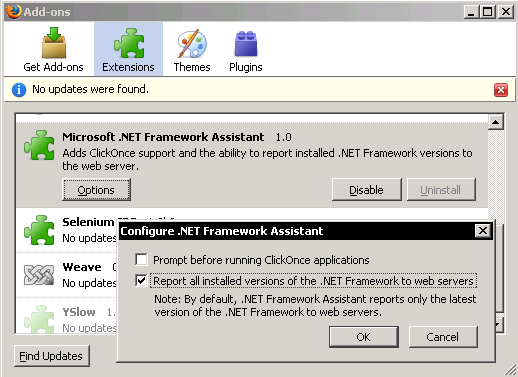
I seem to be late to this party, but one of the security updates for Windows XP (.NET 3.5) silently installs a Firefox plugin that:

  1. tells every web server you visit which version of the .NET framework you have, in my case
<tt>Mozilla/5.0 (Windows; U; Windows NT 5.1; en-US; rv:1.9.0.7) Gecko/2009021910 Firefox/3.0.7 (.NET CLR 3.5.30729)</tt>
  1. allows websites to install software on your desktop using ClickOnce, a mechanism so abysmally stupid in its insecurity it gives ActiveX a run for its money.
Screen shot of the Microsoft .NET Framework Assistant add-on

The reason why Microsoft is doing this is to increase penetration of its also-ran Silverlight competitor to Flash for the 20-30% of Windows users who use Firefox instead of Internet Exploder. To make matters worse, the plugin uninstallation button is grayed out. A Microsoft staffer has published instructions on removing this on his blog.

This behavior is of course completely unacceptable. Perhaps Adobe will now join the line of Microsoft-bashers at the European Commission.

Update (2009-10-18):

Good news: Mozilla responded quickly to block this piece of malware. That should also disable Silverlight altogether. Two birds with one stone.

I decided to take action and wrote a letter (PDF) to EC Commissioner Neelie Kroes, apparently the only person in the world who has the cojones to confront Microsoft about its practices.

Circular logic

I never liked Research In Motion’s Blackberry phones. They have excellent support for Microsoft Exchange, but were abysmal for standards-based POP and IMAP. It used to be the only way to do so was to use their webmail client (for all I know, this is still the case). This completely defeats the purpose of a mobile email client. Hey RIM, the nineties called, they want their mobile email back… Even my old Nokia Series 40 dumbphones could do better. If this weren’t enough of a deal-breaker, the stunted web browser would seal its fate.

I was amused to see RIM’s recent marketing messages, like “The world’s first touch-screen Blackberry!” or “The first flip-phone BlackBerry!”. In other words: “our products are so calamitous we dare only compare them to our older models, not to any meaningful competitors”…

Then again, their core market is Windows/Exchange shops that will resonate with the Inferior But Marketable argument.

Write-only memory, a.k.a web surveys

I just dropped out of a Cisco customer satisfaction survey, after realizing the six pages I already filled out represent only 20% of the entire survey. I don’t know why they think they can make such unreasonable demands on people’s time.

Like most clueless surveys, they feature multiple inane questions where you are supposed to answer vague and irrelevant questions several times on a scale of 1 to 5. There are open text fields for feedback, but the likelihood of actual humans reading them is so low, it just isn’t worth my time to fill them out.

The ideal survey should have only three fields:

  1. one to say whether you are satisfied or not (and this is a binary field, not on a scale of 1 to 5 or whatever).
  2. a free-form text field for feedback. The company asking for the survey should commit to having an actual human read each feedback, and be empowered to take action. If it isn’t worth having a human read it, it’s not worth my filling it. Outsourcing a survey to SurveyMonkey or one of the myriad automated surveying firms just demonstrates that you are not really serious about feedback.
  3. an optional field for an email address so you can ask follow-up questions.

Update apps on exit, not startup

Most programs now include an online version check. This is a mixed blessing – there has definitely been a loosening of QA standards since the days when software shipped on shiny discs and distributing updates was very expensive.

Another, more subtle issue is that most of these programs check or updates on startup. Guess what? That’s precisely when I least want to be interrupted by housekeeping administrivia. Just let me get on with my work already.

Others, like Java, arrogate to themselves the right to keep an application running just to periodically check for updates, even if you never use the application in question. This slows down system startup time for a task that will be useful for a few minutes per year at best, and only shows how arrogant and narcissistic these companies are with their assumption that the universe revolves around them and they have the right to steal other people’s time and computer resources.

The best solution would be for Apple and Microsoft to open up their respective software update systems to cover third-party software under a unified interface. Failing that, programs should be rewritten to check on exit or after an extended period of inactivity, to be less disruptive to the user’s flow.

Update (2009-02-02):

I tried to update Google Earth on my laptop and discovered that it installs the incredibly obnoxious Google updater. Well, at least Google Earth 5.0 has the decency to disclose this fact, unlike previous versions of the updater.

I refused to accept installation of the updater, and uninstalled Google Earth altogether. I generally distrus Google (my browser is set to reject their cookies, for instance) and this doesn’t help.